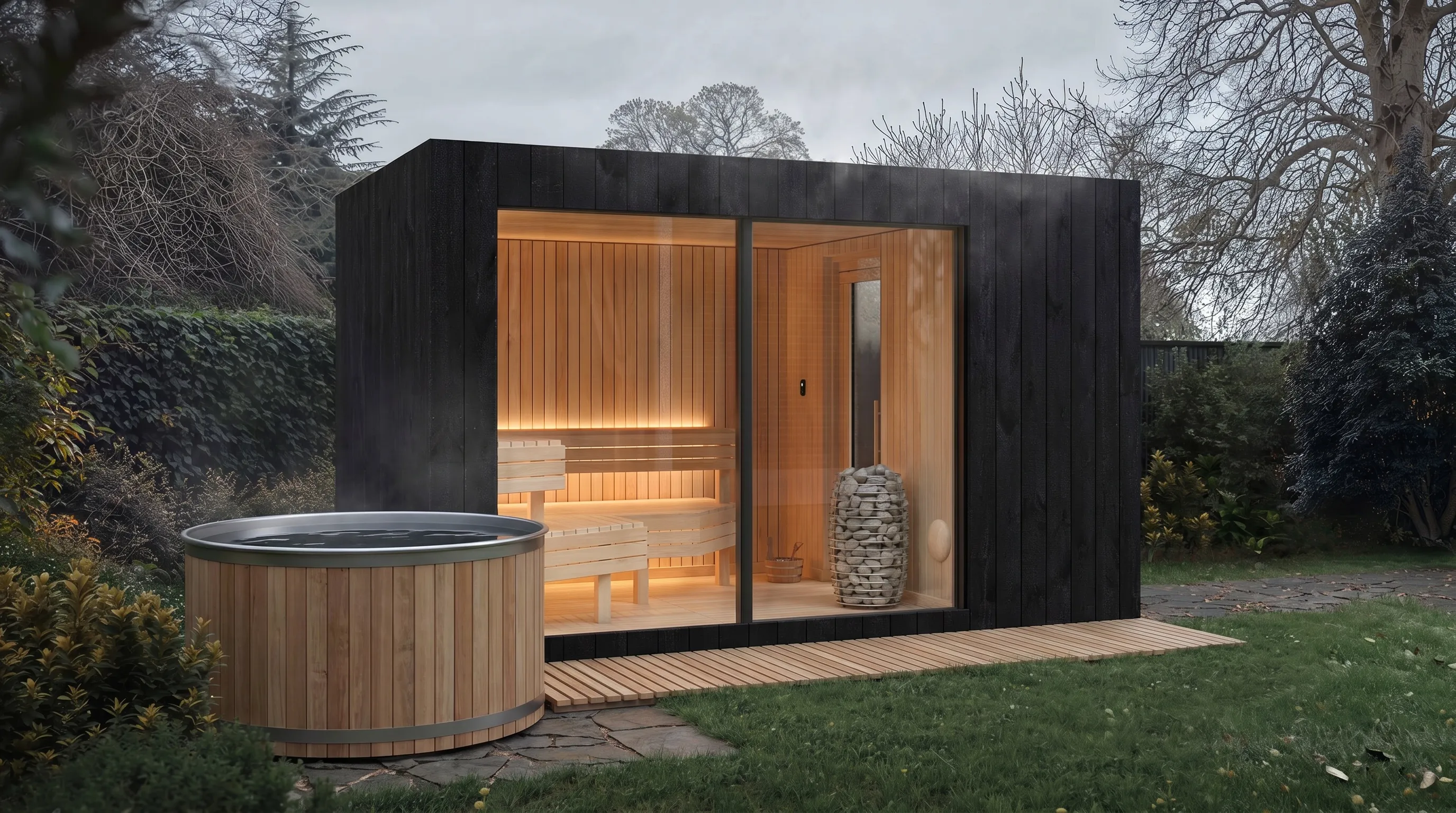
For sauna clubs
For you, the cabin is the till.
Session economics you can check line by line — capacity, price, utilisation — on a cabin engineered for all-day duty.
Gross session revenue against the $45,000 cabin. Check the math yourself.
A 50-minute slot holds 4–5 bathers — sold per seat or as a private hire, your per-slot revenue is the number you control. Three utilisation scenarios, every input on the table:
| Scenario | Revenue / slot | Slots / day | Days / week | Gross / year | Cabin paid back in |
|---|---|---|---|---|---|
| Quiet start | $30 | 3 | 5 | $23,400 | 24 months |
| Steady book | $60 | 5 | 6 | $93,600 | 6 months |
| Full calendar | $90 | 7 | 7 | $229,320 | 3 months |
Arithmetic on the stated inputs — not a forecast. Gross session revenue only: excludes staffing, rent, energy (~3–4 kWh per heat-up cycle), and payment fees. Replace the per-slot figure with your own pricing before you believe any row.
The public-sauna wave
The UK went from 45 public sauna sites to 147 in two years.
That count is the British Sauna Society's, reported in 2025 — and the pattern behind it repeats across the map: small operators opening outdoor cabin saunas on ground they don't own, selling sessions, and expanding site by site. The venture-funded bathhouses get the headlines; the cabins on the shoreline get the bookings.
Most of those sites run exactly this format — a compact outdoor cabin, a cold rinse, a bench, a booking page. What separates the ones still trading in year three is the hardware: a public calendar is roughly ten times a family's use, and kit-grade cabins show it by the second winter.
The four decisions behind those year-three survivors: how to start a sauna business — venue, license, cabin, calendar.
What a cabin sold by the session has to be built to, and what the site has to provide: commercial sauna — duty spec, real cost, site requirements.
The math, on your numbers.
Estimated annual incremental revenue
$—
- Payback period
- — months
- Investment
- $—
Arithmetic on the figures you enter — not a revenue forecast or guarantee. This counts direct session revenue only; it excludes membership and peak-slot effects — model those on your own numbers — plus operating cost, financing, and tax.
Hardware that survives a fully-booked week, certified.
- HUUM Estonian-engineered heater Drop 6 kW — Red Dot Design Award, 2015
- ThermoWood-D Heat-treatment class Thermo-treated wood cladding, 190°C — dimensionally stable outdoors
- 50-year EPDM membrane warranty Held with the membrane manufacturer
The venue dossier: what a first-time operator actually needs.
Foundation evidence for the landlord or licensing authority, electrical and water requirements, the session-economics model with your pricing, and the phased path from one cabin to a full circuit.
- Full material specification + supplier certificates
- Electrical, foundation, and structural-load drawings
- Per-property ROI model (your ADR, occupancy, unit count)
- Lead-time + install-day sequence, base by base
What founders ask before the dossier
-
We're on licensed ground — a car park lease, a shoreline concession. Does that work?
It's the case the foundation was designed for. Six helical piles, no concrete, no excavation — installed in a morning, unscrewed at end of term with the ground left as found. For a landlord or licensing authority, "fully removable" is usually the sentence that turns a refusal into a yes. And if the venue outgrows the site, the cabin moves with you.
-
Can it really run a fully-booked public calendar?
The cabin is engineered for seven-nights-a-week hospitality duty: HUUM Drop 6 kW with no filters and no moving parts, Canadian hemlock chosen for closed-grain stability through constant heat-humidity cycling, 304-grade stainless hardware (316 coastal). Public-session frequency is reviewed against the commissioning schedule before launch — bring your intended timetable to the scoping call.
-
How many guests per session slot?
4–5 bathers. Clubs run it three ways: per-seat public sessions, private whole-cabin hires at a premium, and recurring member slots. The 50-minute session with a 10-minute reset is the rhythm the sector settles into — six to eight slots a day at full swing.
-
What does a second cabin do to the economics?
More than double. Two cabins let you run staggered entries (a session starting every 30 minutes), separate quiet and social sessions, and keep selling during the hygiene reset. Because the spec is identical, the second cabin is operationally free — same SOP, same parts, same heater. Multi-cabin siting is part of circuit scoping.
-
How fast can we open?
The cabin ships in 8–12 weeks by scope and is installed in under two hours by crane. In practice the venue timeline is set by your licensing, changing provision, and water — not by us. Many first-time operators phase it: open with the cabin plus a cold barrel and a bench, add the changing-room module when the calendar proves out.
Bring the venue idea. We'll pressure-test the numbers.
A 30-minute call on your site, your lease terms, and your session pricing — then the venue dossier with the economics table rebuilt on your figures.
Sauna clubs, bathhouses, lido and shoreline operators, first-time sauna founders.