The tradition

Finnish-style.
Honest about what that means.

The sauna at wellnessbyNOOK is Finnish-style — built to the 2,000-year bathing tradition that UNESCO recognised as Intangible Cultural Heritage of Humanity in 2020. It is not manufactured in Finland; it is built across Spain, Germany, and Florida. That distinction matters.

Heritage · Materials · Build · No medical claims

Finnish saunas are not a category — they are a practice. The practice is older than the country. The cabin you stand in is the surface; the tradition is what the cabin makes possible.

What "Finnish-style" actually means.

A Finnish sauna is defined by what it does, not by where it is built. The defining elements: dry heat (60–100°C), low humidity unless the bather throws water on the stones (löyly), wood interior, and a heat source that radiates from a stone-loaded stove. There is no "Finnish certification" body that mints cabins. There is the tradition, the materials, and the build discipline. UNESCO recognised the bathing tradition as Intangible Cultural Heritage of Humanity in 2020. That is the recognition that matters.

Where we sit, exactly.

wellnessbyNOOK builds Finnish-style cabins to the tradition's material and operational standards. The cabins are built in Valencia (Spain), the Black Forest (Germany), or Sarasota (Florida) — whichever base minimises freight and lead time to the install address. We do not claim, and have never claimed, that the cabin is manufactured in Finland. The HUUM heater that ships inside is Estonian-engineered by a three-generation stove-making family with Finnish roots. That is the closest the cabin gets to Finland; we are explicit about it.
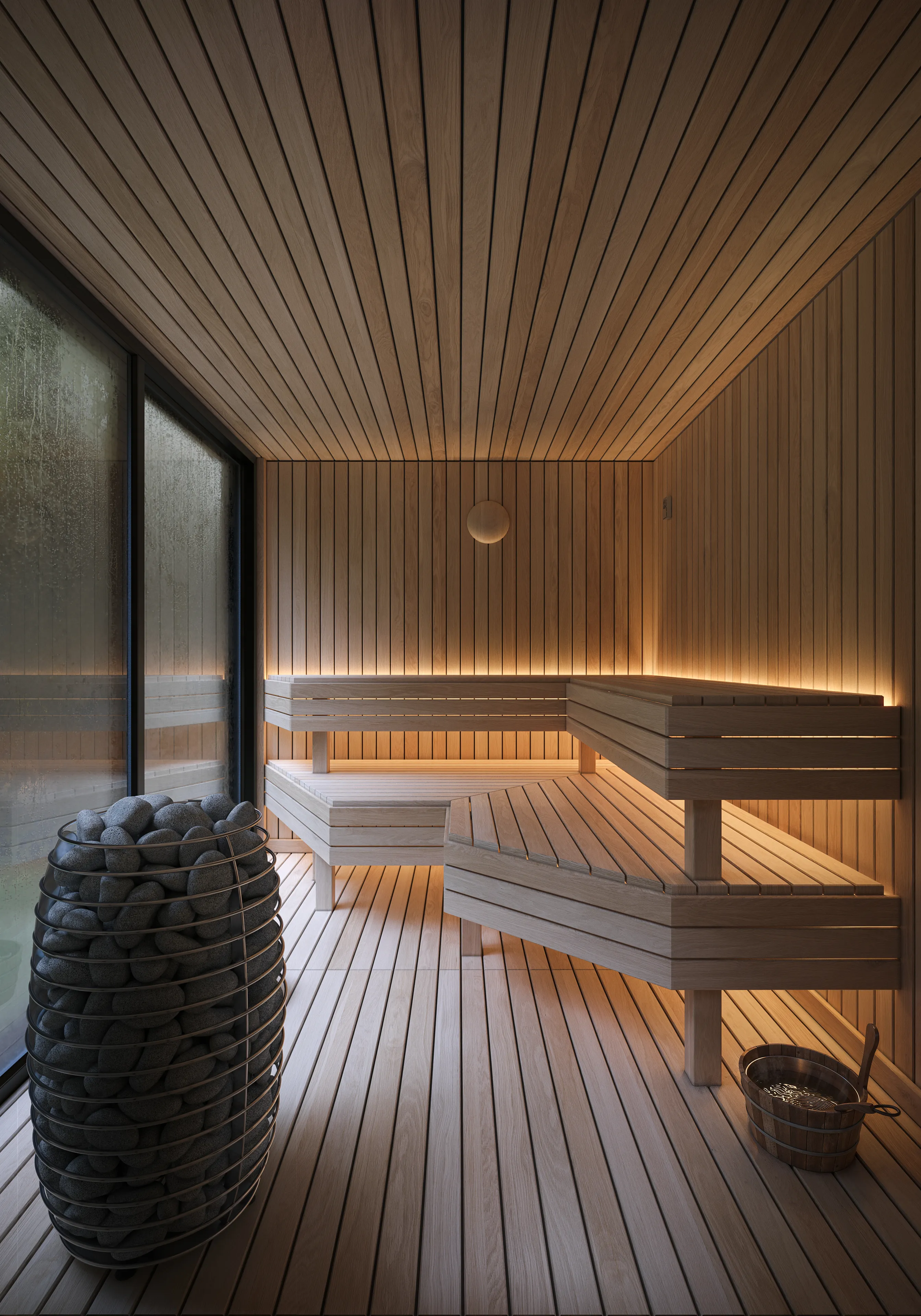
What the tradition asks of the materials

Interior cladding of the NOOK Outdoor Sauna — Canadian hemlock, panoramic glass, indirect warm-white LED
Canadian hemlock interior — 21 mm tongue-and-groove, PEFC chain-of-custody certified, closed-grain and low-resin so it stays cool to the touch at 100°C. NOOK Prefab, 2026
Materials — and why

The decisions the tradition forces.

Interior cladding
Canadian hemlock — the industry benchmark Closed-grain, low-resin, dimensionally stable through the heat-humidity cycle. Cool to the touch at 100°C. PEFC chain-of-custody certified.
Why not pine inside
Resin pockets and knots leach at heat Pine interiors are common in budget cabins. They drip resin from the knots at sustained 80°C+ heat. We do not specify them.
Why not MDF anywhere
Formaldehyde off-gas at sauna temperatures MDF binders release formaldehyde above 60°C. The material is banned from the cabin at every layer.
Exterior cladding
Thermowood pine — heat-treated to ThermoWood-D 190°C heat treatment lowers moisture absorption to under 10% and gives the timber a thirty-year service life outdoors.
Heater
Stone-loaded stove — radiant heat, löyly enabled HUUM Drop 6 kW with ~30–35 kg olivine stones. Coil-only heaters cannot deliver löyly; the tradition requires stone.
Insulation
80 mm high-density rock-wool λ 0.034 W/mK. Energy Rating A officially verified. Holds 80°C inside while -10°C outside.

Sources cited on this page

  • UNESCO Intangible Cultural Heritage of Humanity inscription — Sauna culture in Finland, 2020. ich.unesco.org
  • PEFC (Programme for the Endorsement of Forest Certification) — chain-of-custody standard for Canadian hemlock supply. pefc.org
  • International Thermowood Association — heat-treatment class definitions (ThermoWood-D). thermowood.fi
  • EN 12150 — European tempered safety glass standard.
  • EN 60335-2-53 — sauna heater electrical safety standard.

No medical or health claims are made on this page or anywhere on wellnessbynook.com. This page is limited to heritage, materials, specification, and build provenance.

Next step

Read the specification. Or walk a property with our team.

The dossier carries every material certificate, every electrical compliance document, and three referenced installations where available.